Yangjia Michuan Taijiquan:
13 Postures
As handed down by Wang Yen-nien (1914-2008)
by Julia Fairchild
Note: Master Wang Yen-nien learned the Yangjia Michuan Taijiquan 13 Postures from his teacher Zhang Qinlin in Taiyuan, Shanxi Province, China, in the mid-1940s.
In 1949, near the end of the Civil War in China, Master Wang fled China and followed Premier and Minister of National Defense Yan Xishan, a native of Shanxi, to Taiwan. When Mr. Yan Xishan was forced out of office by Mr. Chiang Kai-shek in 1950, all those loyal to Mr. Yan Xishan, including Master Wang, stepped down with him and retired from military service.
Now, no longer part of the military, Master Wang, still young (36 years old,) began teaching Yangjia Michuan Taijiquan in a park near his house. Eventually he met other martial artists, both young and old, who had also fled China to Taiwan. Together, in 1960, they established the first taijiquan association in Taiwan: the China Taijiquan Club (Zhongguo Taijiquan Julebu). Then, in the mid-1970s, during the early developmental years of Taijiquan in Taiwan, a national taijiquan association, representing all styles of taijiquan in Taiwan, gradually evolved and eventually received government recognition (1975.) http://www.ymti.org/us/int/hist.php
Master Wang, as a founding member of this association, was vice-chairman under Chairman Shi Jue when he was put in charge of forming a committee to develop a short form suitable for all members to practice when meeting for demonstrations and other large (national) group activities. Among the members of this committee were the chief teachers of the major styles represented in the association, such as Wu Style, Chen Style, Yang Style, etc. Each one was asked to choose a short sequence representing the essence of their style to be included in this short national form.
When it came down to putting a unified form together, committee members decided to use Master Wang's Yangjia Michuan Taijiquan 13 Postures as a foundation. The committee then edited and added sequences: the first four cardinal axis movements of the Yangjia Michuan Taiijiquan 13 Postures were edited; the second set of cardinal axis movements were deleted; and the last set of diagonal movements were kept more or less intact.
The last set of diagonal movements includes examples of taijiquan's eight basic hand movements: peng, lu, an, ji, cai, lie, zhou and kao; and examples of taijiquan's five basic feet movements: moving forward, stepping back, turning right, turning left and staying centered - in essence, the soul of taijiquan is contained in this last set of diagonal movements. In addition, these diagonal movements can be practiced with a partner as a separate set, called Ba Fa, the 15th of the Yangjia Michuan Taijiquan Tuishou Basic Exercises. http://www.ymti.org/us/int/class5-7.php
Upon the death of Shi Jue, the ROC-Taiwan National Tai Ch'i Ch'uan Association Chairman in 1986, Master Wang was elected the association's new chairman. In that role, Master Wang helped promote and demonstrate this new form, which emanated from the Yangjia Michuan Taijiquan 13 Postures. Under its new name, "Simplified 13 Postures" it has been further modified, promoted and demonstrated by Mr. Chan Te-sheng, the current president, and one of Master Wang's students.
Since the ROC-Taiwan National Tai Ch'i Ch'uan Association's simplified Taijiquan style (13 Postures) is based on the Yangjia Michuan Taijiquan 13 Postures, many people confuse the two or mistakenly believe Master Wang created Yangjia Michuan Taijiquan's 13 Postures. To add to the confusion, Mr. Chan Te-sheng, after adding his own modifications, is mistakenly credited as being the originator of the ROC-Taiwan National Tai Ch'i Ch'uan Association's 13 Postures.
http://www.ymti.org/us/modules/xoopsfaq/index.php?cat_id=1
The number "13" and the name "13 Postures," or "Shi San Shi" in Pinyin, is not unique to Yangjia Michuan Taijiquan. Historically, many different styles of martial arts, both internal and external, used the number thirteen to designate one of the sets of movements practiced within their system. For example:
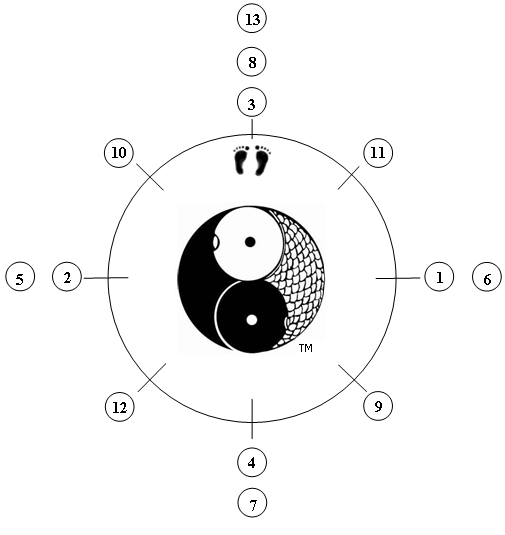
|
Part: |
Section & Movement Name: | Direction: |
|
Part 1: |
1.0 Get Ready; Begin |
0 |
|
Part 2: |
2.0 First Set (Cardinal Axis) | 1-4 |
|
|
2.1 Turn Right 90 Degrees; Right Peng; Right Grasp the Sparrow's Tail; Right Seal It Closed. |
1 |
|
|
2.2 Turn Left 180 Degrees; Left Peng; Left Grasp the Sparrow's Tail; Left Seal It Closed. |
2 |
|
|
2.3 Turn Right 90 Degrees; Right Peng; Right Grasp the Sparrow's Tail; Right Seal It Closed. |
3 |
|
|
2.4 Turn Left 180 degrees; Left Peng; Left Grasp the Sparrow's Tail; Left Seal It Closed. |
4 |
| Part 3: | 3.0 Second Set (Cardinal Axis) | 5-8 |
|
|
3.1 Turning Right 90 Degrees; Right Cai; Right Brush the Knee; Right Wield the Pipa. |
5 |
|
|
3.2 Turning Left 180 Degrees; Left Cai; Left Brush the Knee; Left Wield the Pipa. |
6 |
|
|
3.3 Turning Right 90 Degrees; Right Cai; Right Brush the Knee; Right Wield the Pipa. |
7 |
|
|
3.4 Turning Left 180 Degrees; Left Cai; Left Brush the Knee; Left Wield the Pipa. |
8 |
| Part 4: | 4.0 Third Set (Diagonal Axis) | 9-12 |
|
|
4.1 Turning Right 135 Degrees; Stepping Forward, Right Cai, Lie, Zhou, Kao; Staying Centered; Stepping Backward, Right Peng, Left Lu, An, Ji. |
9 |
|
|
4.2 Turning Left 180 Degrees; Stepping Forward, Left Cai, Lie, Zhou, Kao; Staying Centered; Stepping Backward, Left Peng, Right Lu, An, Ji. |
10 |
|
|
4.3 Turning Right 90 Degrees; Stepping Forward, Right Cai, Lie, Zhou, Kao; Staying Centered; Stepping Backward, Right Peng, Left Lu, An, Ji. |
11 |
|
|
4.4 Turning Left 180 Degrees; Stepping Forward, Left Cai, Lie, Zhou, Kao; Staying Centered; Stepping Backward, Left Peng, Right Lu, An, Ji. |
12 |
| Part 5: | 5.0 The Ending | 13 |
|
|
5.1 Turning Right 135 Degrees; Crisscross Hands; Carry the Tiger Back to the Mountain; Attain Oneness with Taiji |
13 |
Copyright © Yen-nien Cultural Association, 2009
Wang Yen-nien Documents Translation Committee
All rights reserved.
The use of a work or part of a work requires obtaining the consent of its author.
Without this agreement, the user runs the risk of being sentenced to pay damages for infringement.